


Καθορισμός της αφλατοξίνης Β1, καρκινογόνου ουσίας της ομάδας 1, σε ελαιούχες καλλιέργειες με το σύστημα Wayeal LCMS-TQ9200 LC-MS/MS
2026-05-22

Αφλατοξίνη Β₁είναι ένας εξαιρετικά τοξικός δευτερογενής μεταβολίτης που παράγεται κυρίως από Ασπεργκίλλους φλαβόςΑνάμεσα στην οικογένεια των αφλατοξινών, παρουσιάζει την ισχυρότερη τοξικότητα και την ευρύτερη κατανομή.Εφαρμόζει τις τοξικές του επιδράσεις αναστέλλοντας την ενδοκυτταρική σύνθεση DNA και RNA και παρεμβαίνοντας στον μεταβολισμό των πρωτεϊνών., με ιδιαίτερα στοχευμένη βλαβερή επίδραση στο ήπαρ.Σε σύγκριση με άλλες μυκοτοξίνες όπως η ωχρατοξίνη και η πατουλίνη, η αφλατοξίνη Β₁Η ουσία αυτή είναι εξαιρετικά τοξική και έχει αποδεδειγμένη καρκινογένεια. Καρκινογόνα της ομάδας 1συχνά ανιχνεύεται σε καλλιέργειες που περιέχουν λάδι, όπως φιστίκια, καλαμπόκι, ξηρούς καρπούς και φυτικά έλαια,καθιστώντας το ένα από τα επικίνδυνα στοιχεία προτεραιότητας για τον έλεγχο της ασφάλειας των τροφίμων παγκοσμίως.
Μολύνσεις με αφλατοξίνη Β₁συνήθως εμφανίζεται όταν οι ελαιούχες καλλιέργειες εκτίθενται σε υψηλές θερμοκρασίες και υψηλή υγρασία κατά τη διάρκεια της φύτευσης, της συγκομιδής ή της αποθήκευσης, οι οποίες προάγουν την ανάπτυξη μύκητες.λόγω των σταθερών χημικών ιδιοτήτων του, αφλατοξίνη Β₁δεν μπορούν να καταστραφούν με συμβατικές θερμοκρασίες μαγειρέματος, γεγονός που οδηγεί σε επαναλαμβανόμενα προβλήματα υπολειμμάτων σε γεωργικά προϊόντα και μεταποιημένα τρόφιμα.
Η βραχυπρόθεσμη κατάποση μιας υψηλής δόσης μπορεί να προκαλέσει οξεία δηλητηρίαση, παρουσιάζοντας συμπτώματα όπως σοβαροί κοιλιακοί πόνοι, έμετος, κίτρινος και ηπατική ανεπάρκεια, τα οποία μπορεί να είναι θανατηφόρα σε σοβαρές περιπτώσεις.Η μακροχρόνια έκθεση σε χαμηλές δόσεις οδηγεί σε συσσώρευση στο ήπαρ, προκαλώντας χρόνια ηπατική βλάβη όπως η ηπατική ίνωση και η κίρρωση, και μπορεί ακόμη και να προκαλέσει πρωτογενή καρκίνο του ήπατος.και άτομα με προϋπάρχουσα ηπατική νόσο, διατρέχουν υψηλότερο κίνδυνο αφλατοξίνης Β₁δηλητηρίαση.
Στην Κίνα, το εθνικό πρότυπο GB 2761-2017 (Εθνικό Πρότυπο Ασφάλειας Τροφίμων) καθορίζει τα ανώτατα όρια καταλοίπων για την αφλατοξίνη Β₁σε διάφορα είδη τροφής. GB 5009.22-2016 (Εθνικό Πρότυπο Ασφάλειας Τροφίμων ∆ προσδιορισμός των αφλατοξινών Β και G στα τρόφιμα)παρέχει επίσημες αναλυτικές μεθόδους για τον προσδιορισμό της αφλατοξίνης Β₁.
Η παρούσα σημείωση εφαρμογής περιγράφει την καθιέρωση μεθόδου υγρής χρωματογραφίας-ανταλληλμένης φάσματος μάζας (LC-MS/MS) αραίωσης ισοτόπων για τον προσδιορισμό της αφλατοξίνης Β.₁χρησιμοποιώντας το σύστημα Wayeal LCMS-TQ9200 LC-MS/MS.
Κλειδιά:Τριπλός τετραπόλος, αφλατοξίνη Β.₁· Χρωματογραφία υγρού αραίωσης ισοτόπων - φασματομετρία μάζας σε τάδεμα.
1. Μέσο και αντιδραστήρες
1.1 Διαμόρφωση οργάνων
Πίνακας 1 Κατάλογος διαμορφώσεων οργάνων
|
- Όχι, όχι, όχι. |
Μονωδική |
Αριθμός |
|
1 |
Σύστημα LCMS-TQ9200 υγρής χρωματογραφίας-ταντέμ φάσματος μάζας |
1 |
|
2 |
P3600 Δυαδική αντλία κλίσης υψηλής πίεσης |
1 |
|
3 |
CT3600 Φούρνος στήλης |
1 |
|
4 |
ΑΣ3600 Αυτοαποδεικτής υπερ-αποτελεσματικότητας |
1 |
|
5 |
Εργασιακό σταθμό συστήματος δεδομένων χρωματογραφίας SmartLab CDS 2.0 |
1 |
|
6 |
C18 1,7μm 2.1x50 mm Στήλη |
1 |
1.2 Αντιδραστήρες και πρότυπα
Πίνακας 2 Αντιδραστήρες και πρότυπα
|
- Όχι, όχι, όχι. |
Αντιδραστήρας & Πρότυπο |
Καθαρότητα / Συγκέντρωση |
|
1 |
Μεθανόλη |
Αξία LC-MS |
|
2 |
Ακετονιτρίλη |
Αξία LC-MS |
|
3 |
Αμινοξείδιο |
Αξία LC-MS |
|
4 |
Αφλατοξίνη Β₁ |
100 ppm |
|
5 |
13C17- Δεν ξέρω.-Αφλατοξίνη Β₁ |
25 ppm |
1.3 Πειραματικό υλικό και βοηθητικός εξοπλισμός
Συσκευή ανάμιξης στρογγυλοειδών
Κεντρίφωση υψηλής ταχύτητας
Αναλυτικό ισοζύγιο
Κεντρίφωση
Συλλέκτης εκχύλισης στερεών φάσεων (SPE) (με αντλία κενού)
Εξάτμισμα αζώτου
Χειροκρότημα
2. Μέθοδος πειράματος
2.1 Προετοιμασία του διαλύματος
2.1.1 5 mmol/L Λύσιμο οξικού αμμώνου:Ζυγίζουμε 0,39 γραμμάρια οξικό αμμώνιο, το διαλύουμε στο νερό και το αραιώνουμε σε 1000 ml. Αναμιγνύουμε καλά.
2.1.1 Λύσιμο μεθανόλης-ακετονιτρίλης:Προσθέστε 100 ml ακετονιτρίλης σε 100 ml μεθανόλης και μετά ανακατέψτε καλά.
2.2 Προεπεξεργασία δειγμάτων
2.2.1 Εξόρυξη δειγμάτων
Πέρασε το αλεύρι σιταριού μέσα από ένα σίττο δοκιμής διαφάνειας 2 mm. Ζύγισε 5g του δείγματος (με ακρίβεια 0,01g) σε ένα σωλήνα φυγοκέντρωσης 50 ml. Προσθέστε 100μL εσωτερικού τυποποιημένου εργασιακού διαλύματος ισοτόπου (100ng/mL), αναμιγνύεται με στρογγυλοποίηση και αφήνεται να παραμείνει για 30 λεπτά. Προστίθενται 20mL διαλύματος μεθανόλης-νερού (70+30, v/v), στρογγυλοποιείται για αναμίξη,και να ταρακουνήσει σε μια τροχιακή αναταραχή για 20 λεπτά. Κεντρίφωση σε 6000 r/min για 10 λεπτά. Συλλογή του υπερεπιβατικού για μετέπειτα χρήση.
2.2.2 Καθαρισμός δείγματος
Μεταφέρεται με ακρίβεια 4 ml του υπερυψωτικού σε ένα δοχείο, προστίθενται 23 ml 1% Triton X-100 σε PBS και αναμιγνύονται καλά.
Μετά την πλήρη αποστράγγιση του αρχικού υγρού στην στήλη ανοσοαφιλίας, μεταφέρετε το ανωτέρω διάλυμα δείγματος σε βαρέλι σύριγγας 50 ml.Ρυθμίζεται ο ρυθμός ροής έτσι ώστε το διάλυμα δείγματος να περνά σταθερά μέσα από τη στήλη με ρυθμό 1 ∆3 ml/min.Μετά την πλήρη αποστράγγιση του διαλύματος δείγματος, προσθέστε 2 × 10 ml νερού στο βαρέλι της σύριγγας και πλύνετε τη στήλη ανοσοαφιλίας με σταθερό ρυθμό ροής.στεγνώστε τη στήλη με αντλία κενού.
Αποσυνδέστε το σύστημα κενού, τοποθετήστε ένα δοκιμαστικό σωλήνα 10 ml κάτω από τη στήλη ανοσοφιλίας, αφαιρέστε το βαρέλι της σύριγγας 50 ml,και προσθέστε 2 × 1 ml μεθανόλης για την εξάλειψη της στήλης με ελεγχόμενο ρυθμό ροής 1 ∆3 ml/minΣτη συνέχεια, στεγνώστε ξανά τη στήλη χρησιμοποιώντας αντλία κενού.Το ελουάτο εξατμίζεται απαλά μέχρι σχεδόν ξηρότητας κάτω από ρεύμα αζώτου σε θερμοκρασία 50 °C. Προσθέστε 1 ml της αρχικής κινητής φάσης, στροβιλίζοντας για 30 δευτερόλεπτα για να διαλυθεί το υπολείμμα.22 μm φίλτρο μεμβράνης, και να συλλέξει το φιλτράτο σε ένα φιαλίδιο αυτο- δειγματοληψίας για την επόμενη ένεση.
2.3 Συνθήκες πειραματισμού
2.3.1 Μέθοδος υγρής χρωματογραφίας
Στήλη: C18, 1.7μΜ, 2.1×50 χιλιοστά
Φάση κινητής φάσης: Α: διάλυμα μεθανόλης-ακετονιτρίλης. Φάση Β: διάλυμα οξικού αμμωνίου 5 mmol/L
Ταχύτητα ροής: 0,3 ml/min
Θερμοκρασία στήλης: 40°Γ
Όγκος ένεσης: 3μL
2.3.2 Μέθοδος φασματομετρίας μάζας
Πίνακας 3 Παραμέτρους φασματομετρίας μάζας σύνθετων ουσιών
|
Συνδυασμός |
Ιόντα προκάτοχων (m/z) |
Ιόνιο προϊόντος (m/z) |
Ενέργεια σύγκρουσης (CE) / V |
|
Αφλατοξίνη Β₁ |
313.0 |
285.0* |
35.0 |
|
313.0 |
241.0 |
40.0 |
|
|
13C17- Δεν ξέρω.-Αφλατοξίνη Β₁ |
330.1 |
301.1* |
32.0 |
|
330.1 |
255.1 |
54.0 |
Σημείωση: Το αστερίσκο (*) υποδηλώνει το ποσοτικό ιόν.
3Το αποτέλεσμα του πειράματος.
3.1 Τυποποιημένο χρωματογράφημα
Ο προσδιορισμός της αφλατοξίνης Β₁και το εσωτερικό πρότυπο ισοτόπου 13C17-αφλατοξίνη Β₁Όπως απεικονίζεται στο σχήμα 1, και τα δύο αναλυτικά στοιχεία έδειξαν εξαιρετικά σχήματα κορυφών και ικανοποιητικές απαντήσεις, πληρώντας τις απαιτήσεις για την πειραματική ανάλυση.
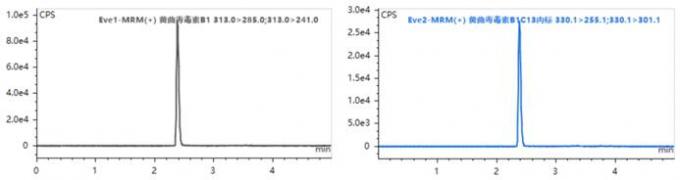
Σχήμα 1 Χρωματογράμματα αφλατοξίνης Β₁και το εσωτερικό πρότυπο ισότοπων 13C17- Δεν ξέρω.-Αφλατοξίνη Β₁
3.2 Γραμμικό εύρος
An appropriate volume of the standard stock solution and mixed isotope internal standard working solution were accurately transferred and diluted with the initial mobile phase to prepare a series of standard working solutions with aflatoxin B₁Κάθε διάλυμα περιείχε το εσωτερικό πρότυπο ισότοπου σε συγκέντρωση 2ng/ml. Κατασκευάστηκε καμπύλη βαθμονόμησης χρησιμοποιώντας αυτά τα πρότυπα.Πάνω από το γραμμικό εύρος 0.5Επικεφαλής50 ng/mL και μετά από διόρθωση με χρήση 13C 17-αφλατοξίνης Β₁ως εσωτερικό πρότυπο, οι αποκλίσεις μεταξύ της μετρούμενης και της ονομαστικής αφλατοξίνης Β₁Ο συντελεστής συσχέτισης (R) ήταν μεγαλύτερος από 0.999, που δείχνει εξαιρετική γραμμικότητα.
Σχήμα 2 Τυπική καμπύλη της αφλατοξίνης Β₁
3.3 Επαναληψιμότητα
Τα αποτελέσματα παρουσιάζονται στον παρακάτω πίνακα.Οι σχετικές τυπικές αποκλίσεις (RSD) των χρόνων κατακράτησης και των ποσοτήτων δειγματοληψίας για την αφλατοξίνη Β₁Σε χαμηλές, μεσαίες και υψηλές συγκεντρώσεις ήταν όλα εντός του 5%, ικανοποιώντας τις απαιτήσεις του πειράματος.
Πίνακας 4 Δοκιμή επαναληψιμότητας για την αφλατοξίνη Β₁σε χαμηλές, μεσαίες και υψηλές συγκεντρώσεις
|
Συνδυασμός |
Συγκέντρωση (ng/mL) |
Χρόνος διατήρησης RSD (%) |
Ποσότητα δείγματος RSD (%) |
|
Αφλατοξίνη Β₁ |
1 |
0.718 |
3.379 |
|
10 |
0.670 |
1.216 |
|
|
20 |
0.544 |
1.749 |
3.4 Ανάκαμψη από ακμή
Αφλατοξίνη Β₁Το δείγμα με το οποίο έγινε η προσθήκη αναλύθηκε στη συνέχεια με LC- MS/ MS. Το μέσο αποτέλεσμα από έξι διαδοχικές ενέσεις ήταν 5.147ng/mlΤο ποσοστό ανάκτησης που υπολογίστηκε ήταν 102,94%, το οποίο πληροί τις απαιτήσεις του πειράματος.
3.5 Άδειο κατάλοιπο
Μετά από συνεχή ένεση του 20 ng/ ml τυποποιημένου διαλύματος, χορηγήθηκε στη συνέχεια ένα κενό δείγμα για την αξιολόγηση της μεταφοράς.
Σχήμα 3 Χρωματογράφημα κενού της ένωσης
3.6 Δοκιμή δείγματος
Αφλατοξίνη Β₁δεν ανιχνεύθηκε στο δείγμα Α (εικόνα 4).
Σχήμα 4 Χρωματογράφημα αφλατοξίνης Β₁στο δείγμα Α
4Συμπεράσματα
Στην παρούσα μελέτη, χρησιμοποιήθηκε μέθοδος υγρής χρωματογραφίας με αραίωση ισότοπων και τανδεματικής φασματομετρίας μάζας (LC-MS/MS) για τον προσδιορισμό της αφλατοξίνης Β.₁Η ανάλυση αυτή πραγματοποιήθηκε με τη χρήση του συστήματος φασματομετρίας μάζας υγρής χρωματογραφίας-ταμέντου Wayeal LCMS-TQ9200.Τα δεδομένα που προκύπτουν αποδεικνύουν ότι όλες οι χρωματογραφικές κορυφές παρουσιάζουν καλά σχήματα κορυφών χωρίς ουρά.Η ευαισθησία πληροί τις πειραματικές απαιτήσεις και ο συντελεστής συσχέτισης (R) είναι μεγαλύτερος από 0.999Η επαναληψιμότητα σε χαμηλές, μεσαίες και υψηλές συγκεντρώσεις είναι εντός 5% και δεν παρατηρείται μεταφορά συστήματος μετά την ένεση δείγματος υψηλής συγκέντρωσης.Τα αποτελέσματα αυτά δείχνουν ότι η μέθοδος, όταν είναι εξοπλισμένο με το σύστημα φασματομετρίας μάζας υγρής χρωματογραφίας-ταμάνδου Wayeal, πληροί τις απαιτήσεις για την τακτική ποιοτική και ποσοτική ανάλυση των δειγμάτων-στόχων.

